We highly recommended purchasing the latest copy of the ARBA Standard of Perfection for full access to the entirety of the latest Lionhead standard, as well as access to all other breeds and general rules and definitions!
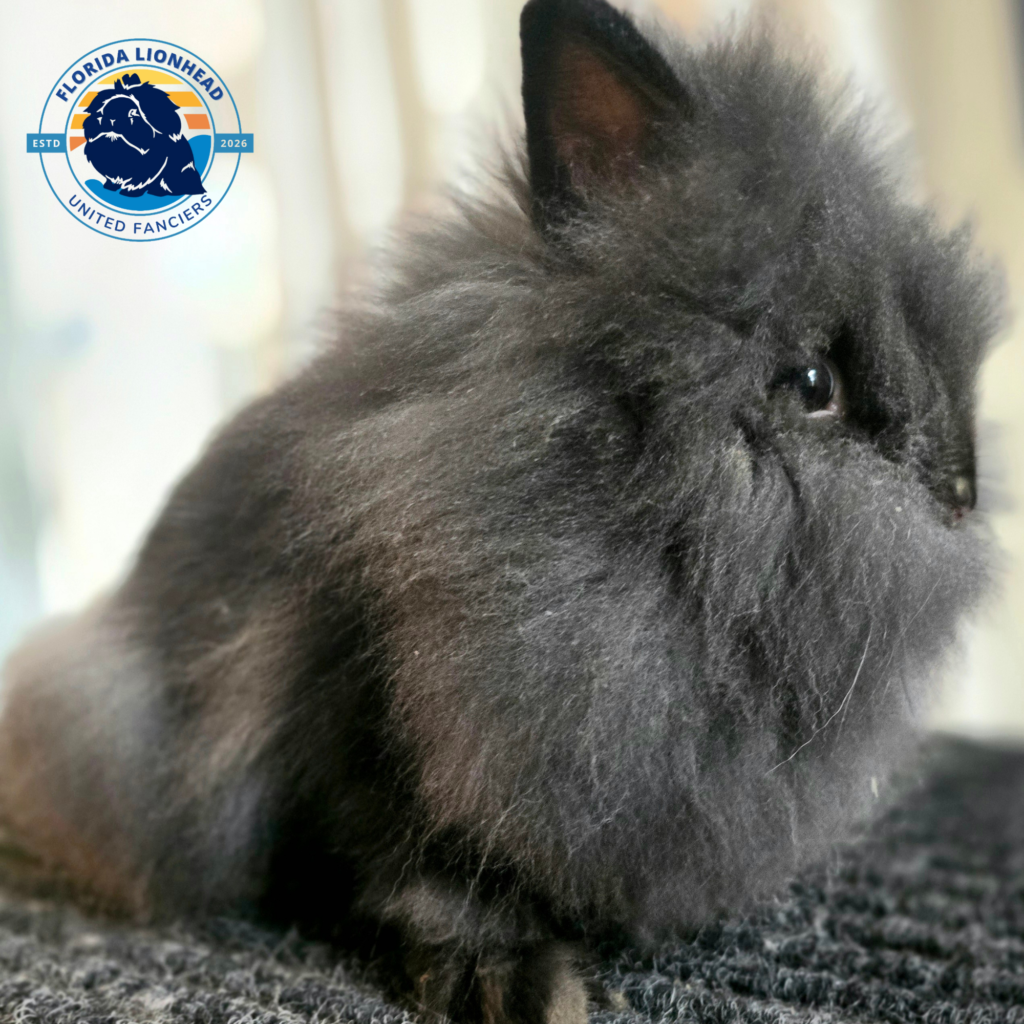
Showing the Lionhead
Lionheads are shown by variety, and by senior bucks and does, and junior bucks and does.
The maximum weight for Lionheads is 3 3/4 lbs. in senior class, and 3 1/2 lbs. in the junior class, and the minimum weight is 1 lb. 10 oz.
Juniors over maximum weight can be shown as a senior, however, no animal can be shown as a lower age than its true age.
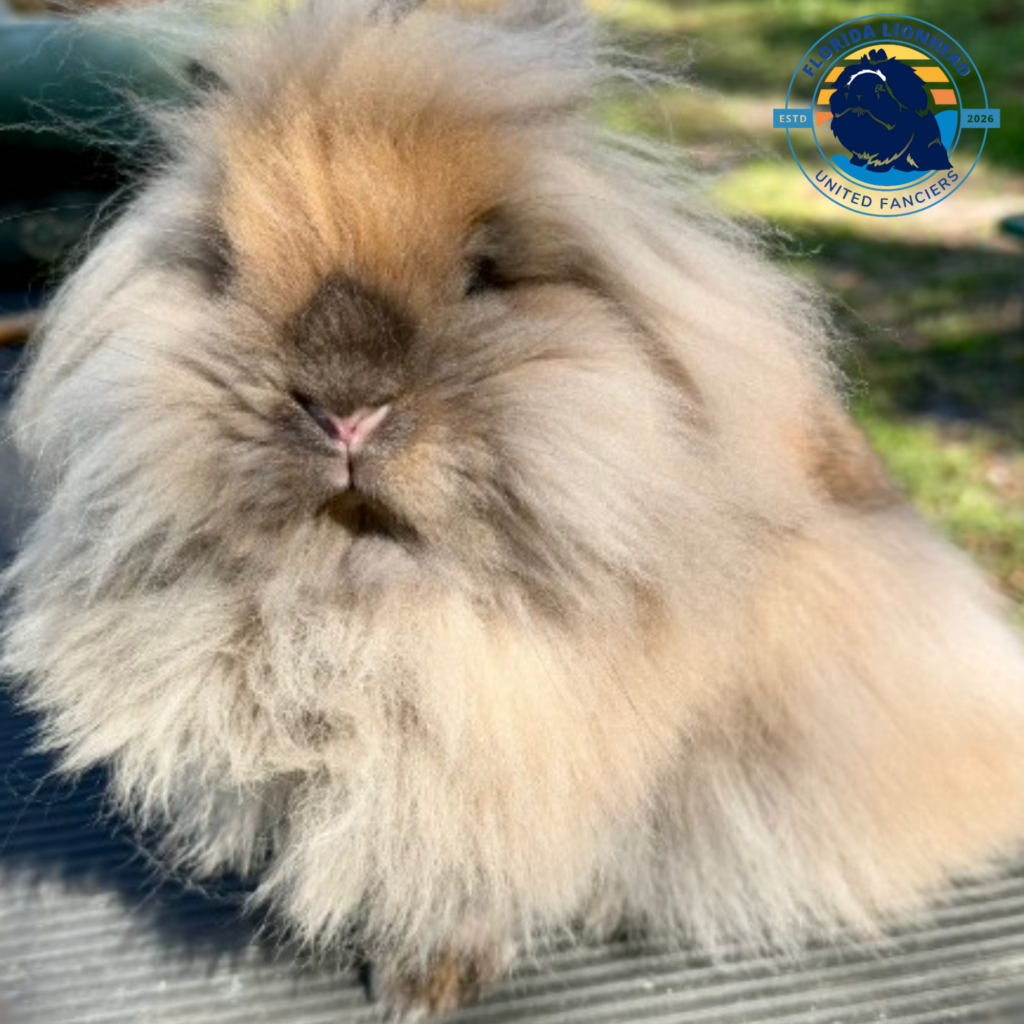
Posing the Lionhead
Lionheads are posed with the front feet resting lightly on the table, posed upright. Their stance should be high enough to show their full chest and mane, and should never be pushed down to see their full posed look.
Body – 25 points
- Short, compact and well rounded
- Topline starts with high head mount, blends into strong shoulders
- Short midsection with smooth hips and full hindquarters
- Broad, well-filled shoulders and chest
- Shoulder width matches hindquarters
- Shoulder depth should allow full chest to show then round back to hindquarters, with slightly less depth
- Hindquarters are broad, deep, and well-rounded
- Lower hips well-filled
- Legs medium length and bone, relative to the size of the rabbit
- Faults:
- Long, narrow body
- Flatness over shoulders or hips
- Fine bone and long limbs
- Chopped off, pinched, or undercut hindquarters
Head – 10 points
- Bold head with a good width and slight roundness between the eyes
- Well filled muzzle
- Head attached with high head mount and no visible neck
- Eyes are bright and bold, and matches variety for eye color
- Faults:
- Long, narrow head
- Pointed or narrow muzzle
- Low headset
- Head that is round from all directions
Ears – 5 points
- Ears erect and well set, but not touching
- When relaxed, in a slight “V”
- Well furred, good substance, and slightly rounded at the tips
- Balance with the head and body
- Faults:
- Pointed ears
- Ears without fur
- Ears that do not balance the body
- Heavy wool more than halfway up the ear
- Disqualifications:
- Ears longer than 3 1/4 inches in length
Mane – 35 points
- Comprised of wool that is strong and full of life with a medium-soft texture and an evident crimp
- Juniors can have softer wool
- Guard hairs can be present, but shouldn’t create a coarse feeling
- Must be at least two inches in length, with no maximum, and form a full circle around the head which may extend a “V” at the back of the neck
- Should be dense enough to make the mane full and prominent
- Wool may appear in front of the ears and across the brow to enhance its prominence
- Wool texture is lustrous with sufficent distribution of guard hairs draped over the crimped underwool
- The mane should end at the start of the separation between the mane wool and the flank wool
- The chest wool, or “bib”, is part of the mane
- The face between and below the eyes to the top of the nose excluding the cheeks may be covered in normal fur or face wool up to 1 1/4″ in length
- The cheeks into the whisker bed may be heavily wooled
- Faults:
- A mane that lacks density or balance
- Wool that is too cottony or prone to felting on a senior
- Disqualifications:
- Lack of any mane, or such poor quality it shows open areas with no wool
- Mane that is less than 2″ in length
- Face wool longer than 1 1/4″
Flank Wool – 0 points
- May or may not be present and may be of similar texture and crimp to the mane
- Quality, uniformity, length, or appearance is never to be taken into consideration
Fur – 10 points
- Rollback fur should cover the face, separation, and saddle
- Fur should be soft, dense, of medium length, and prime
- Show lots of life and glossiness
- Saddle must be free of wool
- Flank wool up to 4″ is allowed
- Note: when shown in breed fur, only the rollback fur on the saddle is judged
- Faults:
- Fur that is long, thin, or poor in texture
- Flank wool longer than 2″
- Disqualifications:
- Wool in the saddle area
Separation
- Located between the mane wool and flank wool, and comprised of fur
- Should be distinct and free of wool
- Formed by fur extending up the side of both forelegs, along the shoulder and on the saddle
- A dense mane may fall onto the area over the shoulders, but the separation is distinct due to the fur on the front legs, shoulders and saddle
- Lift the longer mane wool up, which should reveal the separation and any wool on sides, flanks, and hips
- Preference given to juniors that show distinct separation since it enhances the prominence of the mane
- Faults:
- Juniors than carry transition wool through the fur of the separation
- Fur that is long, thin, or poor in texture
- Flank wool longer than 2″
- Disqualifications:
- Lack of a separation between the wool of the mane and any wool on the sides, flanks and hips
- Flank wool over 4″ in length
Condition – 5 points
- Definite appearance of health and vigor
- Bold and bright of eye
- Good coat, firmly set in the pelt
- Firm in flesh covering
- Not too fat, with soft, flabby flesh; not too thin with a bony effect
- Flesh is deep and even over the body
- Faults:
- In molt or out of condition
- Hutch stains
- Stray white hairs in colored fur
- Poor tail or ear carriage
- Poor eye color
- Flabby or overly fat; or think and extremely poor flesh
- Disqualifications:
- Abnormalities, ill health
- Altering appearance of animal
- Genitalia missing or split penis
- Overweight or underweight
- Permanent Ear Mark issue
- Structural disqualification (spinal problem, missing teeth, missing or miscolored toenail, etc.)
- Wrong sex, breed, group, or variety